Research · Accessibility · Computer vision
WAID
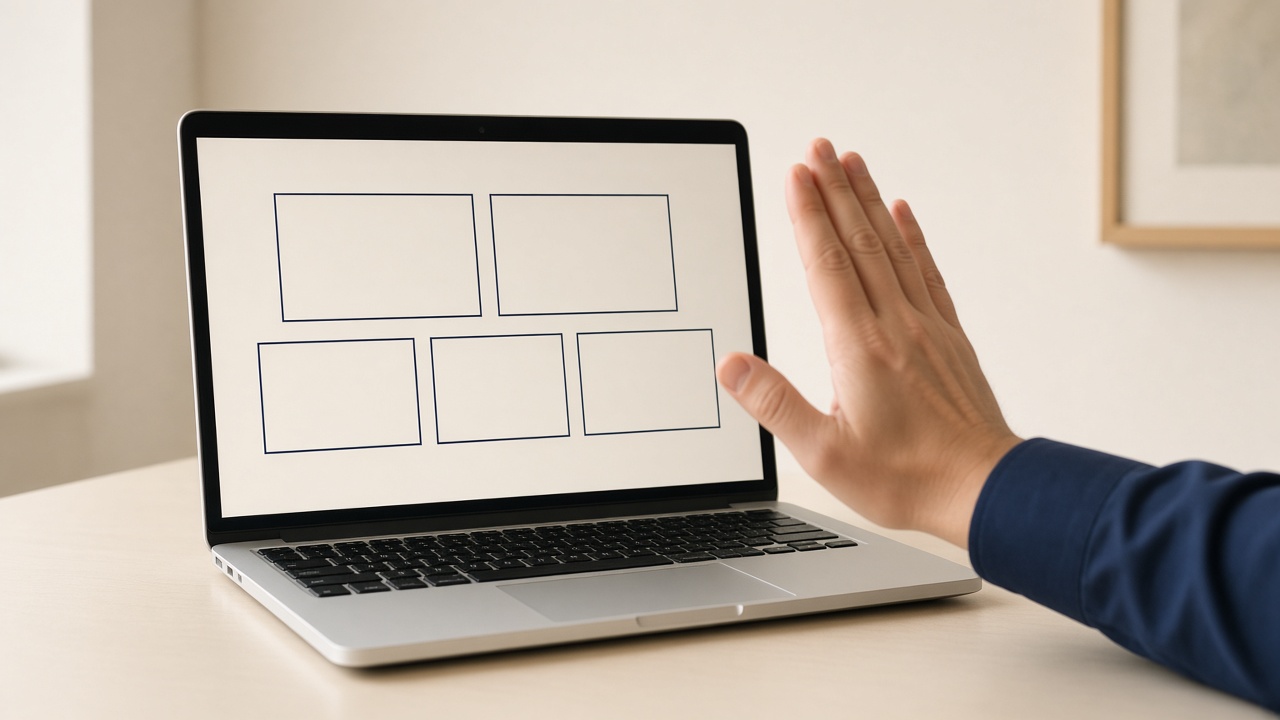
A technology demonstrator for a website you operate without touching the mouse or the keyboard: hand gestures in front of the camera, voice commands in, speech out.
Context
Most of the web still assumes two hands on a desk. That leaves out people who cannot use a pointer, and it leaves out situations where the hands are busy — a workshop, a kitchen, a clinic. The question was whether a page could be driven from the body and the voice the way it is driven from a mouse.
What we built
A browser demonstrator. The camera watches for hand gestures and maps them to navigation and controls. The microphone takes spoken commands. The page answers with text-to-speech, so the loop is not only input: the system talks back.
Outcome
WAID stayed a demonstrator — the point was to show the interaction, not to productise it. The gesture-detection work did not stop there: it became the computer-vision base of later ophthalmic measurement, including the line of work behind Eye Doctor.
Hands and voice
Input is two channels on purpose. Gestures cover pointing, selecting and moving through a page when speech is noisy or unavailable. Voice covers commands that are faster to say than to mime — go to a named view, confirm, go back. Neither channel requires a physical pointing device. The camera and the microphone are the whole hardware list.
Output is not only pixels. A text-to-speech API reads the system’s responses, which is what makes the demonstrator usable as an accessibility sketch and not only as a hands-free novelty. A person who cannot see the pointer still gets a closed loop.
Who it is for
The obvious case is accessibility: people who cannot operate a mouse or a keyboard, including scenarios aimed at users with visual impairment. The less obvious case is everyone else, briefly: sterile or dirty hands, a presentation, a machine that should not be touched. WAID treated those as the same interface problem.
What followed
The project was never meant to be a shipping product. It was meant to prove that a web application could be controlled from the body, in the browser, with the tools of the time — JavaScript, HTML, CSS, and computer vision on the camera feed.
The gesture algorithm was the part that survived. It was reused as the vision foundation for EyeFit: measurements such as pupillary distance and pantoscopic angle, taken from a device in the room rather than from a ruler. That clinical measurement work is what later sits inside the Eye Doctor tablet product.